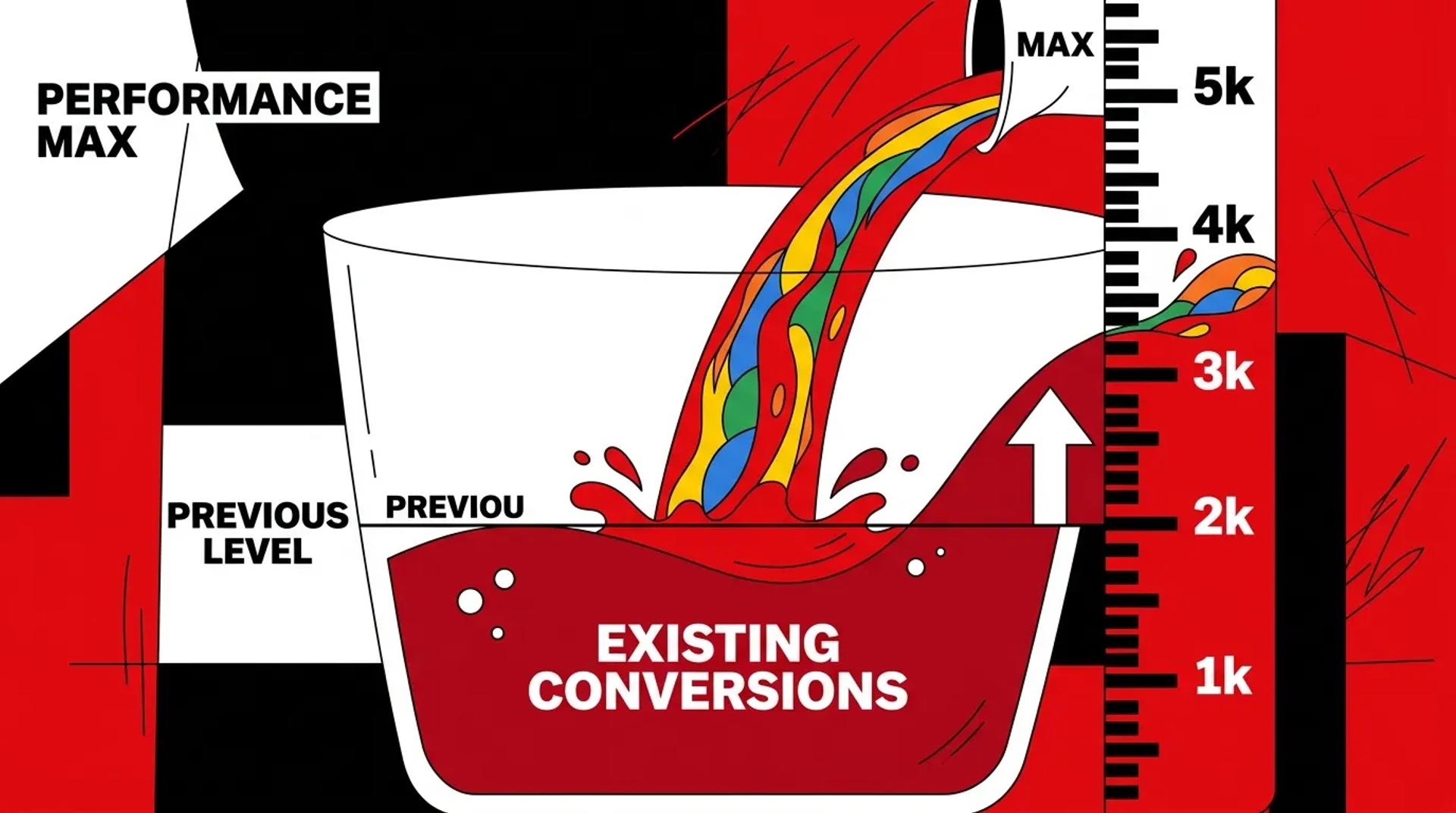

Performance Max is Google’s fastest-growing campaign type, and it is also the one most likely to mislead you about its own results. The platform-reported conversions look impressive. Low CPA, high volume, strong ROAS. But those numbers regularly fall apart when you dig into what PMax is actually doing versus what your other campaigns would have captured anyway.
The core question every advertiser running PMax needs to answer is simple. If I turned this campaign off, would my total conversions drop? Or would my Search campaigns, LSAs, and organic pick up most of that volume? Learning to measure Performance Max incrementality is the difference between a channel that grows your business and one that takes credit for growth that was already happening.
We audit PMax accounts regularly and the pattern is consistent. Most lead gen advertisers running PMax are overvaluing it by 30-60% because they are relying on Google’s own reporting to evaluate Google’s own product.
Why platform-reported PMax numbers are unreliable
Google reports PMax conversions using its attribution model, which counts any conversion that PMax touched in the conversion window. The problem is that PMax runs across Search, Display, YouTube, Gmail, Maps, and Discover simultaneously. It touches a lot of paths that would have converted anyway.
The specific issues:
- Brand cannibalization. PMax bids on branded search terms by default. If someone searches your company name and converts, PMax claims it. Your brand campaign or organic listing would have caught that lead regardless.
- Display and YouTube touchpoints inflating attribution. A user sees a PMax display ad, then searches your brand name and converts. PMax gets credit for the full conversion even though the search intent was already there.
- Cross-channel double counting. PMax and your Search campaigns can both claim the same conversion if the user interacted with both.
- Limited search term visibility. Google only shows a fraction of the search terms PMax matched. You cannot see whether it is capturing new demand or feasting on existing demand.
This is not a conspiracy. It is how the attribution system works. Google designed PMax to be easy to adopt, and the reporting makes it look like the right decision. Your job is to verify.
What incrementality actually means
Incrementality is the additional business outcome that PMax creates beyond what your other channels would have produced without it. If PMax generates 100 conversions and 60 of those would have happened through Search, organic, or direct anyway, then PMax is only 40% incremental.
How to think about it:
| Scenario | PMax-Reported Conversions | Truly Incremental | Incrementality Rate |
|---|---|---|---|
| Heavy brand cannibalization | 100 | 20-30 | 20-30% |
| Moderate overlap | 100 | 40-60 | 40-60% |
| Strong incremental demand | 100 | 70-85 | 70-85% |
| Pure prospecting (rare for lead gen) | 100 | 85-95 | 85-95% |
Most lead gen accounts we audit fall into the “heavy brand cannibalization” or “moderate overlap” range. Pure prospecting performance from PMax is rare in service verticals because the product works best when it has existing conversion signals to optimize against. Those signals usually come from people who already know your brand.
How to test incrementality with geo experiments
The most rigorous way to measure Performance Max incrementality is a geo-based holdout test. This means running PMax in some markets and not others, then comparing total business results.
How to run the test:
- Select two groups of similar markets. Matched by population, revenue history, and competitive intensity
- Run PMax in the test group. Pause it in the control group
- Keep all other campaigns (Search, LSAs, organic) identical in both groups
- Run the test for 4-6 weeks minimum to account for variance
- Compare total leads, total booked jobs, and total revenue between groups
What to measure:
- Did the PMax markets generate more total leads (from all sources combined)?
- Did cost per booked job improve in the PMax markets?
- Did the control markets see their Search and organic leads increase to compensate?
If turning off PMax in the control markets does not reduce total leads significantly, PMax is not incremental. It is just claiming credit for leads your other channels would have captured.
Use CRM data to expose brand overlap
You do not need a formal geo test to start assessing incrementality. Your CRM can reveal a lot about what PMax is really doing.
CRM-based incrementality checks:
- Tag every lead by source channel. PMax, Search branded, Search non-branded, LSA, organic
- Compare lead volume trends. When PMax spend increased, did total leads increase proportionally? Or did Search and organic leads decrease?
- Check for duplicate contacts. Are PMax “conversions” people who were already in your CRM from another channel?
- Analyze first-touch vs last-touch attribution. What was the first interaction for PMax-attributed conversions? If the first touch was organic or branded Search, PMax is getting last-touch credit for existing demand
The brand overlap test
Pull your PMax conversion data and cross-reference it with branded search volume trends.
- If branded search volume is flat but PMax is claiming branded conversions, it is cannibalizing your brand campaign
- If branded search volume drops when PMax launches, PMax is capturing queries that would have gone to your brand campaign
- If non-branded search volume stays flat while PMax reports strong results, PMax is likely claiming credit for demand driven by other channels
This analysis takes an hour and can save you thousands in misallocated budget. It is the first thing we do when evaluating Performance Max strategy for a new client.
Which experiments and comparisons help
Beyond geo holdouts and CRM analysis, there are several practical tests to measure Performance Max incrementality.
The pause test
Turn off PMax for 2-3 weeks. Monitor total lead volume across all channels. If total leads barely change, PMax was not incremental. This is blunt but effective. The risk is temporary volume dips if PMax was doing some real work, so do this during a low-impact period.
The budget reduction test
Instead of pausing entirely, cut PMax budget by 50%. If PMax conversions drop by 50% but total conversions only drop by 10-15%, most of the PMax volume was cannibalizing other channels.
The brand exclusion test
Add your brand terms to PMax exclusions (Google now allows this in some accounts). If PMax conversion volume drops by 40-60% after brand exclusions, that tells you exactly how much of its reported performance was branded demand it should never have claimed.
Search term comparison
Use the PMax search term insights report (limited but available) and compare to your Search campaign terms. High overlap = low incrementality. New terms you have never targeted in Search = genuine incremental discovery.
| Test Type | Effort | Accuracy | Time Required |
|---|---|---|---|
| Geo holdout | High | Highest | 4-6 weeks |
| Pause test | Low | Medium | 2-3 weeks |
| Budget reduction | Low | Medium | 2-3 weeks |
| Brand exclusion | Medium | Medium-High | 4 weeks |
| CRM analysis | Medium | Medium | 1-2 hours (ongoing) |
Common PMax mistakes that destroy incrementality
Even when PMax does have incremental value, common PMax mistakes can eliminate that value or make it impossible to measure.
- No brand exclusions. PMax defaults to bidding on your brand. Without exclusions, it will always look like the best performer because brand converts at the highest rate
- Weak conversion actions. If PMax optimizes toward form fills without lead quality signals, it finds the cheapest path to a form submission, not the cheapest path to a booked job
- No offline conversion imports. PMax needs real revenue data to optimize properly. Without it, the algorithm chases surface-level conversions
- Too many asset groups. Diluting signals across many asset groups prevents the algorithm from learning efficiently
- No audience signals. Skipping audience signals gives Google zero context about who you want to reach, which leads to broad, low-quality prospecting
Building a PMax measurement framework
If you are going to run PMax, build a measurement system that holds it accountable. Do not rely on Google to tell you Google’s product is working.
Monthly PMax accountability checklist:
- Compare total lead volume (all channels) month over month. Is it growing?
- Check branded search volume trends against PMax conversion claims
- Review CRM data for PMax-attributed leads. Close rate, revenue, quality score
- Calculate true incremental CPA. PMax spend divided by incremental conversions only
- Compare PMax cost per booked job against Search cost per booked job
If PMax cost per booked job (adjusted for incrementality) is more than 30% higher than Search, the budget is better deployed elsewhere.
Frequently asked questions
Is Performance Max worth running for lead gen businesses?
It can be, but only with proper measurement. For lead gen, PMax works best as a prospecting and awareness tool with Search campaigns handling high-intent capture. If you run PMax without incrementality tracking, you will overpay for leads you would have gotten anyway.
How do I exclude brand terms from Performance Max?
Google now allows brand exclusions in PMax for some accounts. Go to Campaign Settings, then Brand Safety, and add your brand terms to the exclusion list. If you do not have access yet, work with your Google rep to request it. This is the single most impactful change for improving PMax incrementality measurement.
What is a good incrementality rate for PMax?
For lead gen, 40-60% incrementality is realistic and acceptable. Below 30% means PMax is primarily cannibalizing other channels. Above 70% is excellent but rare. Measure it quarterly and adjust budget allocation based on the actual incremental CPA, not the platform-reported CPA.
Should I run PMax alongside Search or replace Search with PMax?
Never replace Search with PMax. Search gives you keyword-level control, full reporting, and the highest intent traffic. PMax should supplement Search by reaching audiences and placements that Search does not cover. The two are complementary when managed correctly and redundant when managed poorly.
Get a real read on your PMax performance
If you are spending on Performance Max without measuring incrementality, you do not know what that budget is actually doing. The platform will always tell you it is working. Your job is to verify. Book a Performance Max Strategy Session to audit your PMax setup, run the right tests, and find out whether your spend is growing the business or just growing Google’s reported numbers.
References
- Google Ads Help Center. About Performance Max Campaigns and Reporting.
- Search Engine Land. How to Measure Performance Max Incrementality.
- Nielsen. Marketing Mix Modeling and Incrementality Testing Best Practices.