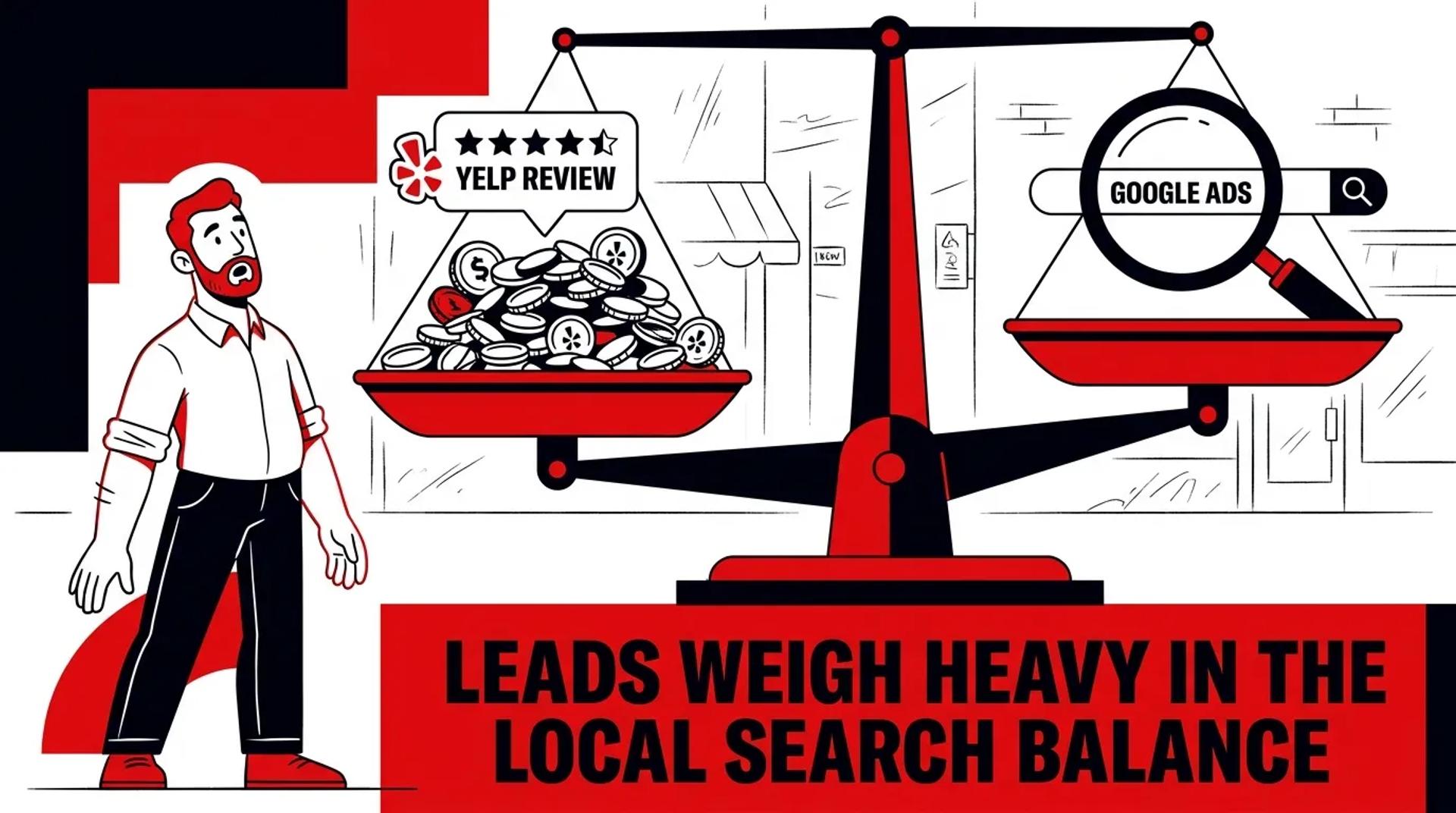
The Yelp vs Google Ads comparison is unique because Yelp is not a typical aggregator. It is a trust platform. Homeowners go to Yelp to read reviews and validate businesses they are already considering. Google Ads captures homeowners at the point of active search. Both channels can deliver local leads, but they capture demand at different stages and through different mechanisms.
Most local service companies we work with are running one or both of these channels without a clear framework for when each one wins. They look at Yelp’s dashboard metrics, look at Google Ads metrics, and try to compare numbers that are not actually measuring the same thing.
We manage Yelp Ads and Google Ads for local service brands. Here is how to evaluate each channel based on what actually drives booked revenue.
How intent differs on Yelp vs Google
Yelp and Google Ads capture fundamentally different types of intent.
Google Ads intent: The homeowner searches for a service. “AC repair near me.” “Best plumber in Austin.” They need something done and are actively looking for a provider. This is direct purchase intent.
Yelp intent: The homeowner searches Yelp for a service category or searches Google and clicks on a Yelp result. They land on your Yelp profile and read reviews. Their intent is validation. They want to confirm that a business is trustworthy before reaching out.
This distinction matters because it affects lead quality and close rates:
- Search intent leads are ready to take action. They are comparing providers and choosing one. Close rates on direct search leads are typically 22-35%.
- Validation intent leads are building confidence. They may have seen your name elsewhere and are checking reviews. Close rates depend heavily on your review profile, star rating, and response history.
When your Yelp profile is strong (4.5+ stars, 100+ reviews, consistent owner responses), Yelp leads convert at competitive rates. When your profile is weak, Yelp becomes a place where potential customers go to disqualify you.
When trust signals matter more than ad copy
Google Ads lets you control the message. Your ad copy, landing page, and call-to-action are all within your control. Yelp flips that dynamic. On Yelp, your customers control the message through reviews.
This creates a different competitive landscape:
| Factor | Yelp | Google Ads |
|---|---|---|
| Message control | Limited (reviews dominate) | Full (ad copy + landing page) |
| Trust building | Reviews, photos, response history | Website, testimonials, brand |
| Competitive visibility | Direct (other businesses on same page) | Indirect (SERP competition) |
| Cost model | CPC on Yelp Ads + enhanced profile | CPC on search + display |
| Lead format | Calls, messages, quote requests | Calls, form fills, clicks |
For businesses with exceptional reviews, Yelp is a trust multiplier. The reviews do your selling for you. A homeowner who reads 50 five-star reviews and then calls you is already pre-sold. That lead might close at 35-40%.
For businesses with mediocre or negative reviews, Yelp works against you. Paid Yelp Ads drive traffic to your profile, and if that profile has 3.5 stars and unhappy customer responses, you are paying to show people reasons not to hire you.
Before investing in Yelp Ads, audit your profile honestly. If it is not a competitive advantage, fix the profile before spending ad dollars.
Where each channel tends to win
Neither Yelp nor Google Ads is universally better. Each wins in specific situations.
Yelp wins when:
- Your review profile is strong (4.5+ stars, 100+ reviews)
- You are in a trust-dependent category (restaurants, medical, legal, home services)
- Your market has high Yelp usage. Yelp penetration varies significantly by city. It is dominant in San Francisco and New York but weaker in many mid-sized markets
- You want leads from homeowners who have already validated your business through reviews
- Your Yelp ROI stays positive when measured at the booked job level
Google Ads wins when:
- You need high-intent, exclusive leads at scale
- You want full control over messaging and the customer journey
- Your market has strong search volume for your service categories
- You can build effective landing pages that convert clicks to calls
- You need a channel that scales predictably with budget increases
Both channels together win when:
- Homeowners search Google, click a Yelp result, read your reviews, and then search for you directly. This multi-touch journey is extremely common
- Your Yelp profile reinforces the message in your Google Ads
- You use Yelp as a trust layer and Google Ads as the demand capture engine
How to compare ROI fairly
Comparing Yelp vs Google Ads requires accounting for the different ways each channel influences revenue.
Step 1: Track direct lead sources
Use unique phone numbers for Yelp and Google Ads. Tag every lead in your CRM by source. This gives you direct attribution for each channel.
Step 2: Measure assisted conversions
Yelp often plays an assist role. A homeowner sees your Google Ad, visits your Yelp page to check reviews, and then calls you directly. In this case, Yelp influenced the conversion but did not get direct attribution. Use call tracking and CRM notes to capture these multi-touch journeys.
Step 3: Calculate cost per booked job
For each channel, divide total spend (Yelp Ads + enhanced profile fees for Yelp, ad spend for Google Ads) by total booked jobs attributed to that channel. This is the core metric for comparison.
Step 4: Factor in profile investment
Yelp requires ongoing profile management. Responding to reviews, updating photos, and maintaining your presence takes time or money. Include that cost in your Yelp Ads management calculation. Google Ads requires landing page optimization and campaign management. Include those costs too. Compare total investment against total revenue.
Step 5: Test incrementality
Pause Yelp Ads for 30 days in select markets while keeping your organic Yelp profile active. Monitor whether total leads and booked jobs change. If they do not, the paid Yelp Ads were not adding incremental value above your organic profile. That tells you whether the ad spend is earning its keep or whether your reviews are doing the work on their own.
How Ad Leverage allocates budget between them
We build channel strategies based on your specific data. Not Yelp’s sales pitch or Google’s case studies. Your CRM data.
For most local service companies, Google Ads is the primary demand capture engine. It scales predictably, delivers exclusive leads, and gives you full control over the customer experience from click to conversion.
Yelp plays a strategic supporting role. If your profile is strong, we run Yelp Ads to amplify that trust signal and capture homeowners in validation mode. If your profile needs work, we focus on review generation and profile optimization before adding paid spend.
The split depends on your market, category, and review strength. Some clients get exceptional Yelp ROI and run substantial budgets there. Others find that their Google Ads campaigns capture the same demand more efficiently and keep Yelp to organic only.
We integrate Yelp lead data, Google Ads performance, and CRM outcomes into a unified dashboard. You see cost per booked job, revenue per channel, close rates, and multi-touch attribution in one place. That visibility drives smarter allocation.
Frequently asked questions
Is Yelp advertising worth it for local businesses?
It depends entirely on your review profile and market. Businesses with 4.5+ stars and 100+ reviews in markets with strong Yelp usage see meaningful Yelp leads from paid ads. Businesses with weak profiles waste money driving traffic to a page that hurts more than it helps. Audit your profile before spending.
How does Yelp lead quality compare to Google Ads?
Yelp leads from homeowners who read your reviews and then contact you are among the highest quality leads available. They are pre-sold on your business. But not all Yelp leads have that profile. Some come from quick searches and are less qualified. On average, Google Ads leads close at higher rates because of the direct search intent, but strong Yelp profiles can close at comparable rates.
Can Yelp and Google Ads work together?
They work very well together. Google Ads captures active search demand. Yelp validates your business during the homeowner’s research process. Many of the best-performing local service companies we manage use Google Ads as the primary driver and Yelp as the trust reinforcement layer. The combined effect is higher overall close rates than either channel alone.
What is the biggest mistake businesses make with Yelp Ads?
Spending on Yelp Ads before fixing their profile. If you have a 3.5-star rating, unresponded reviews, or sparse profile content, paid ads will send more eyeballs to a page that undermines trust. Invest in review generation, response management, and profile completeness first. Then layer on paid Yelp Ads management once your profile is a selling asset.
Find out which channel earns its budget
If you are running Yelp and Google Ads without a clear view of which one is driving booked revenue, you are leaving optimization on the table. Talk to a Directory Strategist and we will build the measurement framework that shows you where to put your next dollar.
References
- Google Ads Help Center. “Multi-Channel Attribution for Local Businesses.”
- HubSpot. “How Online Reviews Impact Consumer Trust and Purchasing Decisions.”
- BrightLocal. “Local Consumer Review Survey: Trends in Review Reading and Trust.”