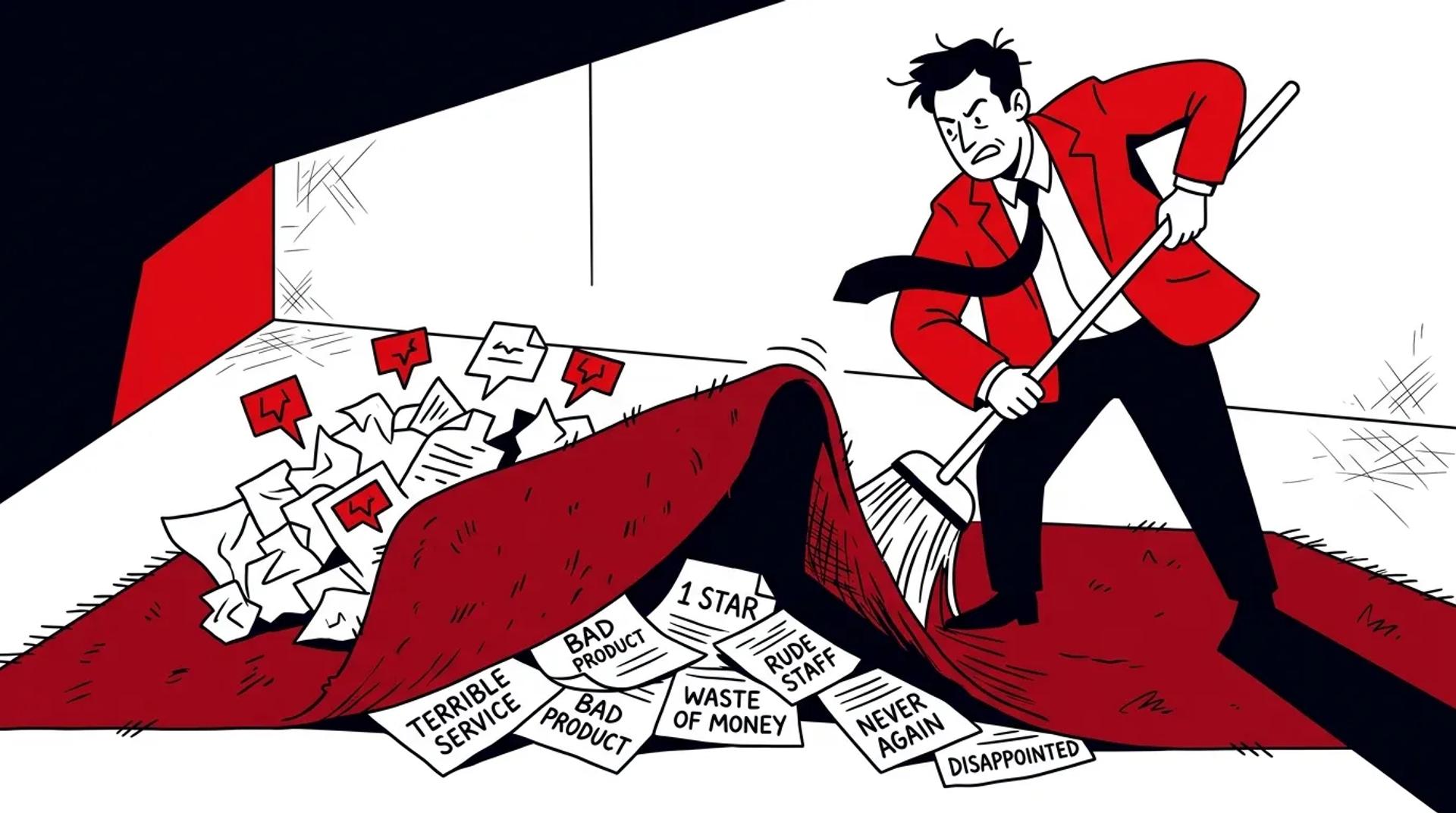

A single unanswered one-star review can cost you six figures in lost revenue over a year. Not because of the review itself, but because every prospect who sees it unanswered draws the same conclusion: this company does not care.
We take over reputation management programs from brands that are frustrated with their online presence. Almost always, the problem is not that they have bad reviews. The problem is that their review generation system is broken, their response strategy is nonexistent, and no one is measuring how reputation impacts conversion rates.
Here are the mistakes we see most often and the frameworks that fix them.
Mistake 1: No systematic review generation process
Most businesses get reviews by accident. A happy customer decides to leave one. An angry customer decides to leave one. The result is a lopsided profile where negative experiences are overrepresented because unhappy customers are 2-3x more likely to leave a review without being asked.
A proper review generation system produces predictable, consistent review volume every month. It is not a campaign or a one-time push. It is a process built into your operations:
- Identify the trigger point: The moment in the customer experience when satisfaction is highest (right after a successful job completion, a positive outcome, a milestone reached)
- Automate the ask: Send a text or email within 2 hours of the trigger point with a direct link to your review platform
- Make it easy: One click to the review form. No account creation barriers. Mobile-friendly.
- Follow up once: If no review after 48 hours, send one reminder. Do not pester.
- Track the funnel: Measure requests sent, reviews received, and conversion rate
| Review Generation Approach | Monthly Review Volume | Predictability |
|---|---|---|
| No system (wait for organic reviews) | 2-5 reviews | Unpredictable, negative-skewed |
| Manual ask (team verbally requests) | 5-15 reviews | Inconsistent, depends on team effort |
| Semi-automated (trigger-based emails) | 15-30 reviews | Consistent, moderate volume |
| Fully automated (integrated with CRM/dispatch) | 30-60+ reviews | Predictable, high volume |
The difference between approach one and approach four is the difference between a 3.8-star rating and a 4.5-star rating within six months.
Mistake 2: Generic or no responses to negative reviews
Responding to a negative review with “We’re sorry you had a negative experience. Please contact us at [email protected]” is barely better than not responding at all. It is a template. The customer knows it. Every prospect reading it knows it.
A strong negative review response strategy is specific, empathetic, and action-oriented:
What a bad response looks like
“We apologize for any inconvenience. Customer satisfaction is our top priority. Please contact our office so we can resolve this matter.”
What a good response looks like
“Thank you for sharing this, [Name]. What you described with the scheduling delay should not have happened, and I understand your frustration. Our operations manager, [Name], is reaching out to you directly today to make this right. We take this seriously.”
The difference matters because the response is not primarily for the reviewer. It is for the hundreds of future prospects who will read the exchange and decide whether to trust your business.
Response framework for negative reviews
- Acknowledge specifically: Name what went wrong. Do not be vague.
- Take ownership: Even if the customer is partially wrong, own your part.
- Describe the action: Explain exactly what you are doing to fix it.
- Name a person: Assign a real person to the resolution. “Our team” is vague. “Sarah, our service manager” is credible.
- Follow up privately: Contact the reviewer directly. If resolved, politely ask if they would consider updating their review.
Mistake 3: Only managing Google and ignoring everything else
Google is the most important review platform for local search visibility. But it is not the only place prospects research your business. Depending on your industry, Yelp, BBB, Angi, Thumbtack, Facebook, and industry-specific directories all influence buying decisions.
Your reputation management strategy should cover every platform where your prospects research:
| Industry | Primary Platform | Secondary Platforms |
|---|---|---|
| Home services | Google Business Profile | Angi, Thumbtack, Yelp, BBB |
| Healthcare | Google Business Profile | Healthgrades, Vitals, Zocdoc |
| Legal | Google Business Profile | Avvo, Martindale, Yelp |
| Restaurants | Google Business Profile | Yelp, TripAdvisor, OpenTable |
| B2B services | Google Business Profile | Clutch, G2, LinkedIn |
Monitor reviews across all relevant platforms weekly. A 4.8 on Google means nothing if you have a 2.5 on Yelp and a prospect checks both.
Mistake 4: Reacting to reviews instead of managing proactively
Waiting for reviews to appear and then responding is reactive reputation management. It means you are always one bad week away from a ratings crisis.
Proactive reputation management looks like this:
- Real-time alerts for new reviews on all platforms (not a weekly digest)
- Sentiment monitoring across social media mentions, not just review sites
- Customer experience tracking that flags potential negative reviews before they happen (low CSAT scores, complaints to service teams, unresolved tickets)
- Competitive monitoring to track how your ratings compare to local competitors weekly
The goal is to identify and resolve issues before they become reviews. Every complaint resolved internally is a negative review prevented.
Mistake 5: Fake reviews or review gating
Some businesses try to shortcut the process by purchasing fake reviews or using review gating (only sending review requests to customers who indicate positive sentiment). Both of these will destroy your review generation system in the long run.
Google actively detects and removes fake reviews, and penalties can include profile suspension. Review gating violates the terms of service of every major review platform.
The better approach is to fix the service issues that cause negative reviews and build a system that generates enough legitimate positive volume to outweigh the occasional negative one.
Mistake 6: No connection between reputation data and business decisions
Reviews contain the most honest feedback your business will ever receive. Customers tell you exactly what is wrong, what delights them, and what your competitors do better. Most businesses read individual reviews but never analyze them systematically.
Build a monthly review analysis that:
- Categorizes reviews by topic (pricing, communication, quality, timeliness)
- Tracks topic trends over time
- Identifies recurring service failures that generate multiple negative reviews
- Feeds insights back to operations and training teams
When your reputation management strategy creates a feedback loop between reviews and operations, you stop treating symptoms and start fixing root causes.
Frequently asked questions
How quickly should we respond to negative reviews?
Within 24 hours. Ideally within 4 hours during business hours. Every hour a negative review sits unanswered, it is being read by prospects who form impressions based on what they see. Speed signals that you care.
Can we get negative reviews removed?
Only if they violate the platform’s policies (fake reviews, reviews for the wrong business, reviews containing threats or hate speech). You can flag these for removal. Legitimate negative reviews cannot and should not be removed. Respond well instead.
How many reviews per month do we need to build a strong profile?
For most local service businesses, 15-30 new reviews per month creates strong momentum. This volume ensures recency, pushes your average in the right direction, and signals to prospects that you are actively serving customers.
Should we respond to positive reviews too?
Yes. Responding to positive reviews increases the likelihood that other customers will leave reviews. Keep responses brief, personal, and genuine. Mention their name and reference something specific from their experience.
Your reputation is a revenue asset. Treat it like one.
A broken review generation system and a nonexistent response strategy cost you leads, close rates, and market share every single day. The fixes are not complicated. They are operational. Build the system, follow the process, and measure the impact.
References
- BrightLocal, “Local Consumer Review Survey”
- Harvard Business School, “Reviews, Reputation, and Revenue”
- Google, “Google Business Profile Review Policies and Best Practices”