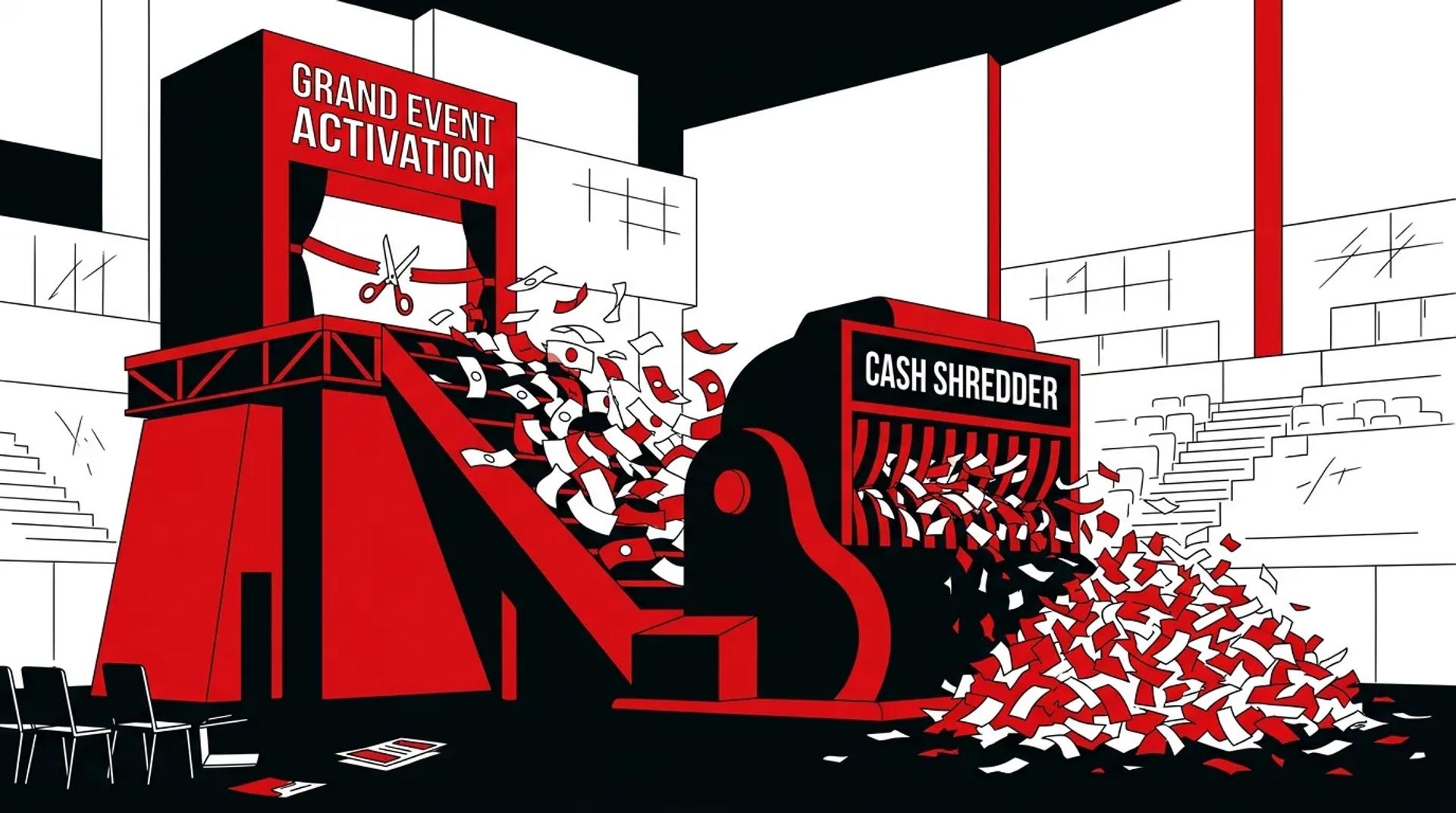

Live event activations are some of the most expensive marketing investments a brand can make. Between booth design, travel, staffing, sponsorships, and production, a single trade show appearance can cost $30,000-$150,000. And most brands walk away with almost nothing to show for it. A few photos on LinkedIn. A spreadsheet of badge scans. A vague sense that “it went well.”
That is not event marketing ROI. That is an expensive trip.
We have planned and executed event activations across industries. The mistakes that waste budget are consistent and predictable. They are not about booth design or location. They are about strategic planning failures that happen weeks before the event and follow-up failures that happen in the days after.
Mistake 1: No content capture plan
This is the most expensive oversight in event marketing. A brand spends $60,000 to be at a trade show and does not budget $3,000-$5,000 for a videographer and photographer to capture content. The event happens, looks great, and produces zero usable content beyond phone photos.
What you lose without content capture:
- 10-15 attendee testimonial clips (worth months of ad creative)
- 50-100 professional photos (worth months of social and web content)
- Product demo recordings (reusable on website and in sales)
- Behind-the-scenes footage (social content goldmine)
- Speaker and panel captures (authority content for months)
The cost comparison:
| Scenario | Event Cost | Content Capture Cost | Assets Produced | Post-Event Content Value |
|---|---|---|---|---|
| No capture plan | $60,000 | $0 | 0 | $0 |
| Professional capture | $60,000 | $5,000 | 40-80 | $20,000-$40,000+ |
The $5,000 content capture investment produces assets that would cost $20,000-$40,000 to produce in studio settings. It is the highest-ROI add-on to any event budget.
Mistake 2: Treating lead capture as badge scanning
Badge scanning tells you who visited your booth. It does not tell you what they are interested in, how ready they are to buy, when they need a solution, or whether they are even a fit. Yet most event teams treat a badge scan as a “lead” and dump them all into the same follow-up sequence.
The badge scan problem:
- No intent data captured
- No qualification criteria applied
- No priority scoring
- All leads get the same generic follow-up
- Sales team treats the entire list with equal (low) priority
How to fix it:
Implement a tiered capture system at the booth:
- Tier 1 (scan only): Basic awareness. Enter nurture sequence.
- Tier 2 (form + conversation): Captured interest area, timeline, budget. Enter targeted follow-up.
- Tier 3 (meeting booked): Qualified, high intent. Goes directly to sales with full context.
Knowing how to capture leads at events properly means capturing intent, not just contact information.
Mistake 3: Slow post-event follow-up
The half-life of an event lead is disturbingly short. A lead that gets contacted within 24 hours of the event converts at 3-5x the rate of one contacted a week later. Yet the average post-event follow-up takes 5-10 business days because the marketing team needs to “clean up the lead list.”
Why follow-up is slow (and how to fix each cause):
| Cause | Fix |
|---|---|
| Leads stuck in spreadsheet | Real-time CRM sync from event |
| No email sequences pre-built | Build all follow-up sequences before the event |
| No lead tiering | Tier at point of capture, not after |
| Sales not briefed | Pre-brief sales on lead tiers, expected volume, and response protocol |
| No clear ownership | Assign follow-up owners by tier before the event |
Every day of delay reduces conversion rates. Pre-build your entire follow-up workflow and test it before the event starts.
Mistake 4: No defined success metrics
“The event went great” is not a metric. Neither is “we got a lot of traffic to the booth.” Without pre-defined success metrics, there is no way to evaluate event marketing ROI or improve the next activation.
Metrics to define before the event:
- Lead volume target by tier: “We will capture 200 Tier 1, 50 Tier 2, and 15 Tier 3 leads.”
- Content capture target: “We will produce 10 testimonial clips and 50 professional photos.”
- Pipeline target: “Event leads will generate $150,000 in pipeline within 90 days.”
- Cost per qualified lead: “Our target CPQL from this event is under $500.”
- Follow-up speed: “All Tier 3 leads contacted within 24 hours. All Tier 2 within 48 hours.”
Set these targets, share them with the entire event team, and review performance against them within 2 weeks of the event.
Mistake 5: Building an experience with no follow-through
Some brands build incredible booth experiences. Interactive demos, immersive installations, custom fabrication. Attendees love it. Photos get posted. And then nothing. There is no mechanism to convert that experience into pipeline.
What the experience should include:
- Capture points at every interaction: QR codes, forms, or scan points embedded in the experience
- Clear next steps: Every attendee should leave the booth knowing exactly what to do next (book a demo, visit a URL, enter a drawing)
- Content documentation: The experience itself should be captured on camera for repurposing
- Sales handoff: High-interest attendees should be routed to an on-site sales meeting, not just sent away with a brochure
An experiential activation without conversion mechanics is entertainment, not marketing. Entertainment does not generate pipeline.
Mistake 6: Ignoring the post-event content window
Event content has a shelf life. Testimonials and professional photos are evergreen. But recap content, crowd footage, and moment-specific posts lose relevance fast.
Content deployment timeline that works:
- During the event: Real-time social posting. Stories, live updates, attendee reactions.
- 24-48 hours post: Quick recap video. Thank-you posts. “In case you missed it” content.
- Week 1: Testimonial clips in organic social rotation. Recap video on YouTube.
- Week 2-4: Testimonials enter paid ad rotation. Photos deployed across web and email.
- Month 2-3: Evergreen content (testimonials, demos) continues running. Event-specific content retired.
If your recap video goes live 6 weeks after the event, you missed the window. The energy and relevance are gone.
Frequently asked questions
What is the average ROI on event marketing?
Most industry benchmarks show event marketing generates $5-$8 in pipeline for every $1 spent. However, this varies dramatically based on your live event activation strategy. Brands with structured lead capture, fast follow-up, and content repurposing consistently outperform those without.
Is it worth attending events if I cannot measure the direct revenue impact?
Only if you are actively working to fix the measurement gap. Attending events without measurement means spending money on faith. At minimum, implement tiered lead capture, CRM sync, and 90-day pipeline tracking. You need to know whether events pay for themselves.
How many staff should I bring to an event activation?
Plan for 2-3 booth staff per shift for conversations and demos, 1 lead capture coordinator, and 1-2 content capture professionals. Understaffing the content and lead roles is the most common mistake. Those roles directly impact your post-event ROI.
What is more important: booth design or follow-up process?
Follow-up process. A mediocre booth with excellent lead capture and 24-hour follow-up will outperform a stunning booth with badge scanning and a 10-day follow-up cycle. Invest in the post-event system first.
Fix your event marketing before the next show
Every dollar you spend on events should be traceable to pipeline and revenue. If it is not, you have a process problem, not a budget problem. Talk to a Live Event Producer at Ad Leverage and we will build an activation strategy that captures leads, content, and revenue from every event.
References
- CEIR (Center for Exhibition Industry Research): ROI and Attendee Engagement Data
- HubSpot: Event Marketing Benchmarks and Best Practices
- Bizzabo: Post-Event Follow-Up and Conversion Studies