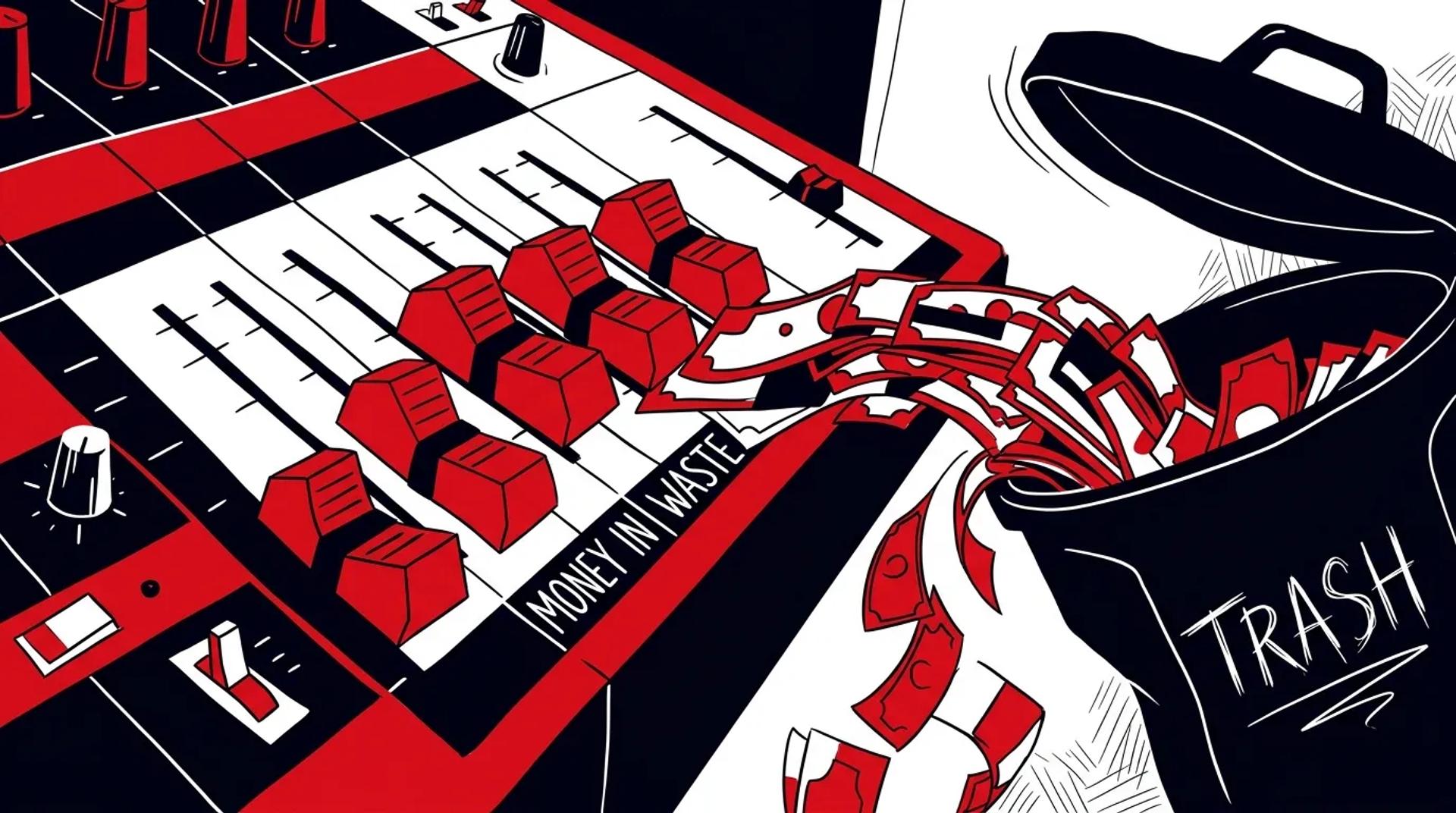

We have reviewed hundreds of radio commercial production budgets over the years. The pattern is remarkably consistent. Brands spend $5,000-$15,000 on audio production, use the output for a single placement, and then produce again from scratch the next quarter. Half the budget goes to waste before the spot even airs because the production was never designed to deliver multi-channel value.
The mistakes that waste audio budgets are not about talent quality or studio acoustics. They are strategic failures. Bad briefs, missing channel plans, no versioning strategy, and zero measurement. Fix these and your audio investment starts compounding instead of evaporating.
Here are the most expensive audio production mistakes we see and exactly how to avoid each one.
Mistake 1: Producing for one channel
This is the single biggest budget killer in radio commercial production. A brand commissions a 30-second radio spot, pays for studio time, voice talent, mixing, and mastering. Then runs it on terrestrial radio only. That same session could have produced 15-20 assets for streaming, podcasts, social, web, phone systems, and sales outreach.
The cost of single-channel thinking:
| Approach | Production Cost | Assets Produced | Cost Per Asset |
|---|---|---|---|
| Single radio spot | $8,000 | 1-2 | $4,000-$8,000 |
| Multi-channel session | $9,500 | 15-20 | $475-$633 |
The multi-channel session costs 15-20% more but produces 8-10x the output. The extra cost covers additional script variations, alternative reads, and longer studio time. It is the best ROI multiplier in audio production.
How to fix it:
Build a channel map before writing the script. List every platform that needs audio content. Plan the session to cover all of them.
Mistake 2: Writing scripts that cannot be versioned
A script that tells one continuous story produces one asset. A modular script produces dozens. Yet most audio production for advertising briefs still deliver a single, linear narrative.
What a non-modular script looks like:
One 30-second block of copy with a beginning, middle, and end baked together. The only way to change the CTA is to re-record. The only way to shorten it is to awkwardly cut content from the middle.
What a modular script looks like:
- Hook (3-5s): Standalone attention-grabber
- Problem (5-8s): Pain point statement
- Solution (5-8s): Value proposition
- Proof (5-8s): Stat or testimonial
- CTA (3-5s): Multiple versions recorded separately
Each module is recorded as an independent take. Your editor can assemble a 30-second broadcast spot, a 15-second streaming ad, a 6-second social hook, and a podcast mid-roll from the same raw audio.
Mistake 3: Hiring talent without channel direction
Booking a voice talent and saying “give us a professional read” produces audio that sounds fine on broadcast but falls flat on social. Different channels demand different delivery styles.
What to direct for each channel:
- Broadcast: Polished, clear enunciation, moderate pace, authority tone
- Streaming/podcast: Conversational, natural pacing, like talking to a friend
- Social: Energetic, slightly raw, personality-forward
- Phone/IVR: Calm, clear, helpful, slightly slower pace
- Sales outreach: Personal, direct, like a one-on-one conversation
Have your talent record the same script in 2-3 different energy levels. This takes an extra 20-30 minutes and saves you from booking a separate session when your social team needs a different feel.
Mistake 4: Skipping the brief entirely
A surprising number of audio sessions start with the talent or producer asking “so what are we making today?” That lack of preparation shows up in every version of the final product.
What a production brief must include:
- Business objective: What is this audio supposed to accomplish? Leads, awareness, sales?
- Target audience: Who is listening? What do they care about?
- Channels: Where will this run? Every channel listed.
- Deliverables: Exact asset list with specs (length, format, loudness standard)
- CTA: What do we want the listener to do? Multiple versions if needed.
- Brand voice: Tone, personality, words to use and avoid
- Timeline: When does each asset need to be live?
- Measurement: How will we track whether this worked?
Without this brief, even excellent talent and studio quality will produce audio with no strategic value. The brief is the single cheapest investment you can make in audio production for advertising.
Mistake 5: No measurement framework
If you cannot connect your audio investment to business outcomes, you cannot optimize it. And if you cannot optimize it, you are guessing with every dollar you spend.
Common measurement failures:
- No unique tracking numbers: Using the same phone number across all audio placements makes attribution impossible
- No UTM parameters: Using “visit our website” instead of a unique URL means you cannot track traffic from audio
- No post-conversion tagging: Not asking “how did you hear about us?” at the point of conversion
- No cost-per-lead tracking: Knowing the production cost but not the lead cost per placement
The measurement setup that works:
- Unique phone numbers per audio placement (costs $5-$20/month each)
- Dedicated landing page URLs per campaign (e.g., yourbrand.com/radio)
- CRM integration that tags lead source by audio placement
- Monthly reporting on cost per lead, cost per opportunity, and revenue attributed per audio channel
This is how you build an audio branding strategy that gets smarter and more efficient every quarter.
Mistake 6: Producing without an asset management system
We cannot count the number of times a client has told us “we might have some audio from a previous shoot” and then could not find the files. Unorganized production output is production that does not get used.
Minimum asset management requirements:
- Consistent file naming:
[campaign]-[channel]-[length]-[version].wav - Shared storage accessible to marketing, sales, and creative teams
- Asset tracker spreadsheet mapping every file to its intended channel, status, and performance
- Quarterly audit to retire underperforming assets and identify gaps
Frequently asked questions
What is the most common reason audio production budgets get wasted?
Single-channel production. Brands pay for studio time, talent, and post-production, then use the output for one placement. Planning for multi-channel output from the start is the highest-leverage fix.
How do I know if my audio production is underperforming?
Calculate your cost per lead from audio placements. If your audio CPL is significantly higher than your CPL from other channels (paid search, social ads), your production or placement strategy needs adjustment. If you cannot calculate audio CPL at all, your measurement setup is the first problem to fix.
Should I invest more in production quality or more in distribution?
Distribution. A well-distributed B+ spot will outperform a poorly distributed A+ spot every time. Get the distribution plan and measurement framework right first. Then invest in incrementally better production quality.
How often should I refresh my audio assets?
Monitor performance monthly. Most radio commercial production assets start showing fatigue after 8-12 weeks on heavy rotation. Streaming and podcast ads can run longer (12-16 weeks) because frequency is typically lower. Refresh based on data, not arbitrary schedules.
Stop wasting your audio production budget
If any of these mistakes describe your current audio production process, the fix is straightforward. Better planning, modular scripting, multi-channel capture, and real measurement. Talk to an Audio Producer at Ad Leverage and we will build a production process that eliminates waste and connects every asset to revenue.
References
- IAB: Digital Audio Advertising Best Practices
- RAB (Radio Advertising Bureau): Effectiveness of Radio Advertising Studies
- HubSpot: Audio Marketing Performance Benchmarks