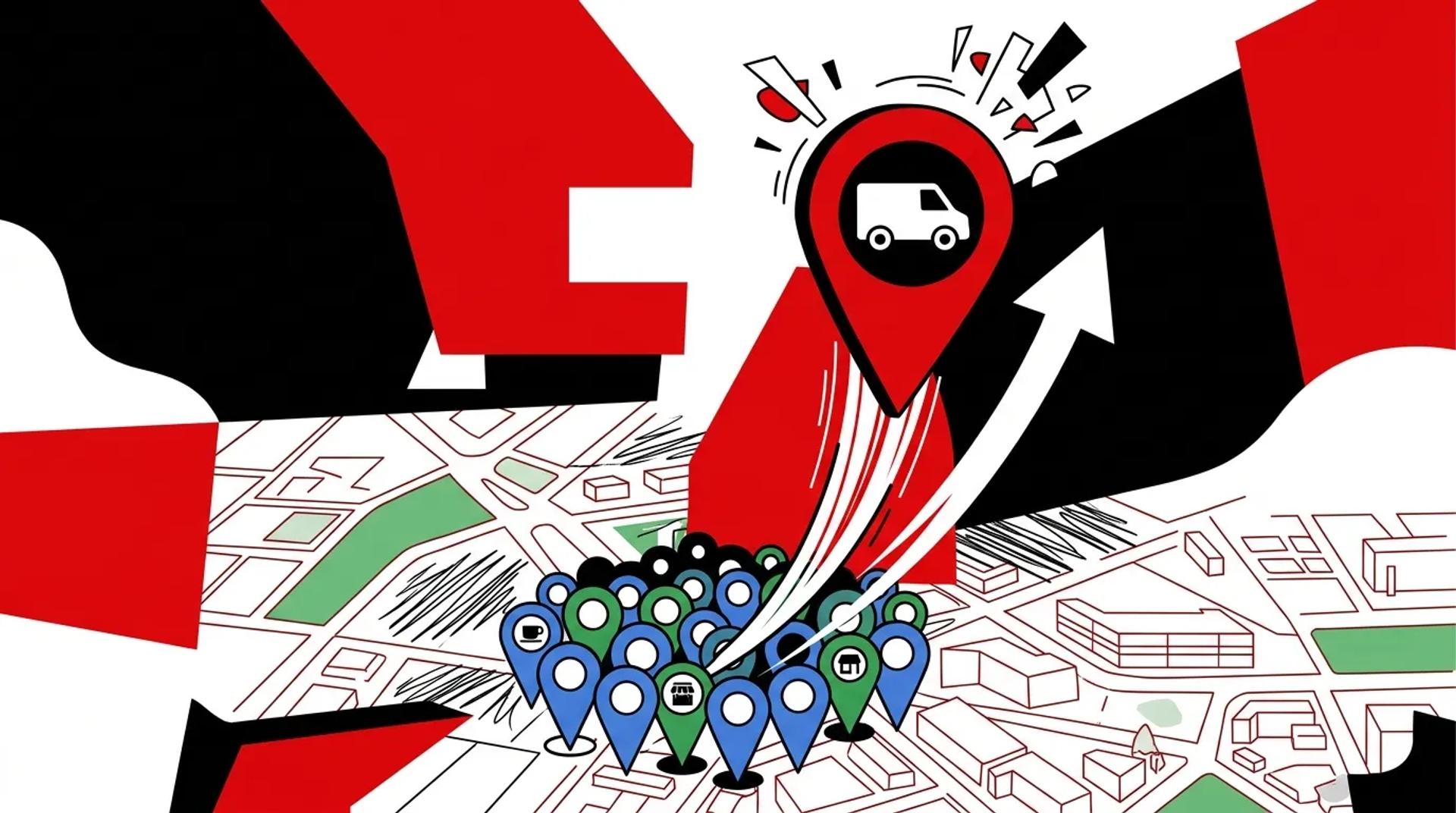

Service area businesses have a unique challenge in local search. Unlike a restaurant or retail store with a fixed storefront, SABs serve customers at their location. That changes how Google evaluates and ranks them in the map pack. And it means the standard advice written for brick-and-mortar businesses does not always apply.
A strong local SEO strategy for service area businesses requires a specific approach to Google Business Profile configuration, website content, reviews, and citation management. Get these fundamentals right and you will consistently appear in front of the buyers who are ready to call. Get them wrong and competitors with weaker service but stronger local signals will take that lead flow instead.
We manage local SEO for HVAC, plumbing, roofing, and multi-location service brands across competitive markets. The playbook below reflects what we see actually working.
What drives Google Maps visibility for SABs
Google uses three core factors to determine map pack rankings: relevance, distance, and prominence. For service area businesses, these factors play out differently than for storefront businesses.
- Relevance is determined by how well your profile and website content match the searcher’s query. Category selection, service descriptions, and on-page content all influence this.
- Distance is calculated from the searcher’s location to your listed service area. Since SABs do not show an address, Google relies on the service area you define and signals from your website and citations.
- Prominence reflects how well-known and trusted your business is. Reviews, citations, website authority, and engagement signals all factor in.
The critical difference for SABs: without a visible address pin on the map, your service area definition and supporting signals carry more weight. This is where most SABs lose ground to competitors.
Step 1: Configure your Google Business Profile correctly
Google Business Profile optimization is the foundation. For SABs specifically, these configuration details matter:
Category selection
- Set your primary category to the most specific match for your core service (e.g., “Plumber” not “Contractor”)
- Add secondary categories for other services you actively provide
- Check competitor profiles in each market to see which categories top-performing businesses use
Service area definition
- List the specific cities, towns, and neighborhoods you serve rather than using a broad radius
- Do not claim areas you cannot realistically service with reasonable response times
- For multi-location brands, avoid excessive overlap between locations’ service areas
- Update service areas as your actual coverage changes
Profile completeness
| Profile element | Why it matters | Common mistake |
|---|---|---|
| Business description | Establishes relevance for your services and markets | Left blank or filled with generic copy |
| Service list | Tells Google exactly what you offer | Missing or incomplete |
| Hours of operation | Signals availability and active business status | Not updated, especially for emergency services |
| Attributes | Adds relevance signals and trust factors | Ignored entirely |
| Photos | Drives engagement and signals active business | No photos or only outdated stock images |
| Products/services menu | Reinforces service offerings with descriptions | Not used |
Step 2: Build service-area pages that earn rankings
Your website needs pages that demonstrate relevance and authority in each market you serve. For SABs, this means dedicated pages for your key service areas.
What strong service-area pages include
- Unique content that reflects the actual market. Mention neighborhood-specific factors, common project types, local building codes, weather-related issues, or anything that shows you genuinely work in that area.
- Service-specific information relevant to that location. Which services are most requested there. What buyers typically need to know.
- Local proof. Reviews from customers in that area, project examples, or case references.
- Clear calls to action with local phone numbers when possible.
- Internal links connecting to your main service pages and other related location pages.
What weak service-area pages look like
- Template copy with only the city name swapped
- No mention of any local detail, market condition, or customer scenario
- No reviews, project examples, or trust signals
- Identical meta descriptions across all location pages
- No internal linking to supporting content
The difference between these two approaches shows up directly in rankings and lead volume. We have seen SABs double their map pack visibility in target markets within 90 days by replacing thin template pages with genuinely differentiated local content.
Step 3: Build and manage reviews systematically
Reviews are one of the strongest Google Maps ranking factors and the primary trust signal for conversion. For SABs competing across multiple markets, review strategy needs to be deliberate.
What matters about reviews
- Volume. You need enough reviews to be competitive. Check your top competitors in each market and aim to match or exceed their count.
- Velocity. Consistent new reviews signal an active, trusted business. A steady stream of 5 to 10 reviews per month beats a large batch followed by silence.
- Quality and detail. Reviews that mention specific services, locations, and outcomes help Google understand what you do and where you do it.
- Response rate. Respond to every review, positive and negative, within 48 hours. Google considers response activity as an engagement signal.
A review generation system that works
- Send a review request within 24 hours of job completion via text or email
- Use a direct link to your Google review page to minimize friction
- Train field teams to mention the review request during the job wrap-up
- Track review volume and average rating weekly as a KPI
- Respond to every review with personalized, professional replies
Step 4: Build consistent citations across the web
Citations are mentions of your business name, address, and phone number on third-party websites. For SABs, citation consistency reinforces the trust signals that support map pack rankings.
Priority citation sources
- Tier 1: Google, Yelp, Facebook, Apple Maps, Bing Places
- Tier 2: Industry-specific directories (HomeAdvisor, Angi, Thumbtack for home services)
- Tier 3: Local directories, chamber of commerce, BBB, local news or community sites
Citation management rules
- Use the exact same business name, phone number, and service area across every listing
- Remove or correct duplicate listings
- Claim and complete profiles on all Tier 1 and Tier 2 sources
- Audit citations quarterly to catch new inconsistencies or unauthorized changes
Step 5: Optimize your website for local search signals
Your GBP does not operate in isolation. Google uses your website to validate and reinforce profile signals. A weak website limits how far your GBP optimization can take you.
Website elements that support local rankings
- NAP consistency. Your business name, address (or service area), and phone number should match your GBP exactly. Place this information in the footer or on a dedicated contact page.
- Local schema markup. Implement LocalBusiness or relevant sub-type schema on your homepage and location pages.
- Mobile performance. Local searches are predominantly mobile. Slow load times and poor mobile usability directly hurt engagement and rankings.
- Service pages with depth. Each core service should have its own page with enough content to demonstrate expertise.
- Blog content addressing local buyer questions. What does a typical project cost in your area. How long does it take. What should homeowners look for in a provider. These are the searches that build topical authority.
The complete local SEO strategy framework for SABs
| Component | Action | Impact on rankings | Impact on conversion |
|---|---|---|---|
| GBP optimization | Correct categories, complete profile, regular posts and photos | High | High |
| Service-area pages | Unique, locally relevant content for each market | High | Medium |
| Review management | Systematic generation and response | High | Very high |
| Citation consistency | Accurate NAP across top directories | Medium | Low |
| Website local content | Service pages, area guides, local FAQ content | Medium | High |
| Technical SEO | Mobile speed, schema, crawlability | Medium | Medium |
The key insight is that no single element wins the map pack on its own. The brands that consistently rank well in competitive local markets invest in all of these layers. The ones that invest in only one or two plateau quickly.
Common mistakes that stall SAB local performance
- Setting an unrealistically large service area. Claiming you serve an entire state dilutes your relevance in the markets that matter.
- Ignoring review velocity. Getting 50 reviews in year one and zero in year two tells Google (and customers) the business has stagnated.
- Publishing template location pages. Thin, duplicated pages hurt more than they help.
- Inconsistent NAP data. Especially common after phone number changes, rebrandings, or address moves.
- Neglecting mobile experience. Over 60% of local searches happen on mobile. A slow, poorly designed mobile site kills conversion.
Frequently asked questions
How long does it take to see results from local SEO for SABs?
Most SABs see measurable improvements in map pack visibility within 60 to 90 days of implementing GBP optimization and review management. Service-area page improvements and citation cleanup typically take 90 to 120 days to show full impact. Sustained competitive advantage requires ongoing investment.
Should SABs hide their address on Google Business Profile?
Yes, if you do not serve customers at your business location. Google’s guidelines require SABs to hide their address and define service areas instead. Showing an address when you do not have a customer-facing location violates guidelines and risks suspension.
How many service-area pages should we create?
Focus on the markets that drive the most revenue first. A plumber serving a metro area might start with 10 to 15 key city pages. Each page must have genuinely unique content. It is better to have 15 strong pages than 50 thin ones.
Do paid directories help with local SEO?
Some do, most do not. Focus on the directories that Google actually trusts and that your target customers use. Industry-specific directories (HomeAdvisor, Angi) carry more weight than generic paid directories. The value is in the citation consistency, not the listing fee.
References
- Google Search Central. Google Business Profile help and local search guidelines.
- BrightLocal. Local search ranking factors study and local consumer review survey.
- Whitespark. Local citation sources and local SEO ranking factor research.
Ready to take control of your local visibility?
If your service area business is not showing up in the map pack for the markets that matter most, the problem is almost always a combination of profile gaps, weak local content, and inconsistent signals. Every one of those issues is fixable.
Book an SEO Strategy Call to get a clear picture of where your local presence stands and what needs to change. We will audit your Google Business Profile, evaluate your service-area pages, and build a local SEO strategy tied to the markets and services that drive the most revenue for your business.