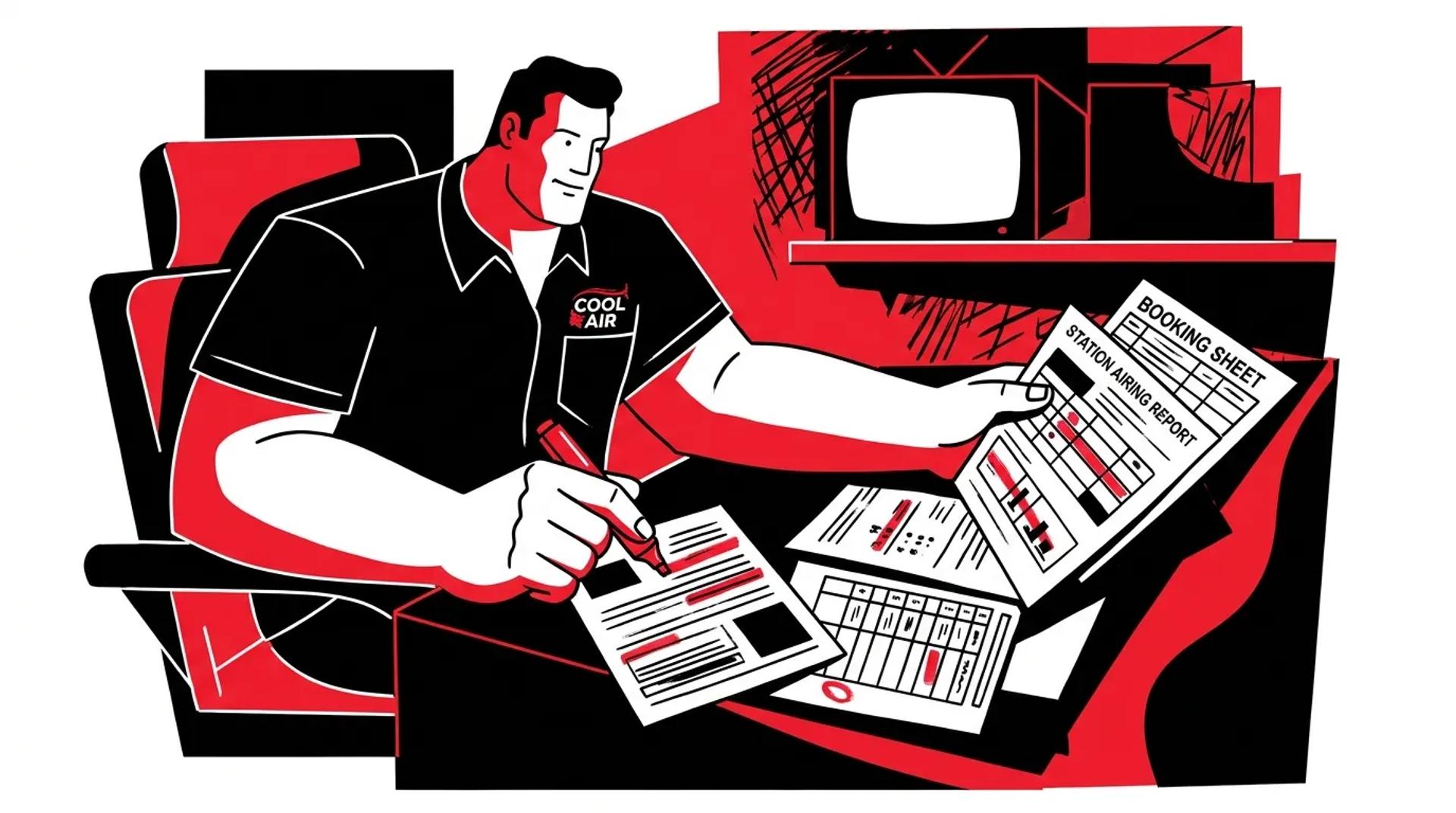

Your fall heating flight was booked weeks ago. Now the station rep is calling about schedule changes, two of last week’s morning news spots never ran, and the first cold mornings are close. That is what advertising during election season feels like for a local HVAC company in a market with heavy midterm spending.
Election Day is Tuesday, Nov 3, 2026. The U.S. Energy Information Administration starts its 2026-27 winter heating season on Nov 1, two days earlier. The loudest stretch of political spending lands right on top of your first no-heat calls.
National brands can skip an expensive market. You can’t leave yours. Below is the local operator’s version: how bumped spots work, what you can ask for, and how to lock in a clean restart on Nov 4.
Key takeaways
- This is a record midterm. AdImpact projects $10.8 billion in political ad spending for the 2025-26 cycle, more than 20% above 2022.
- Your regular spots are usually preemptible. When a campaign or PAC pays more, stations can bump you, and only proof-of-airing reports will tell you it happened.
- Makegoods have to be chased. Claim them in writing with an air-by date before the heating peak, not after it.
- Non-preemptible time exists. Federal rules let stations sell it to candidates only if they also offer it in good faith to commercial advertisers, so ask for it.
- Reserve your Nov 4 restart now. Heating season starts Nov 1, and post-election inventory goes to whoever booked it first.
Why election season hits local HVAC advertisers harder in 2026
More political money is chasing the same local airtime during the exact weeks your heating demand starts, and a local company has nowhere else to go. National advertisers can move budget to quieter markets. You can only move it to other channels or other weeks.
The money is bigger than last midterm
AdImpact projects $10.8 billion in political advertising for the 2025-26 cycle, which it calls the most expensive midterm on record and more than 20% above 2022. About $5 billion of that is expected on House and Senate races, the kind of contests that buy local broadcast heavily.
AdImpact’s 2024 projection landed within 5% of the actual $11.2 billion, so its forecasts are worth taking seriously when you plan your October and November schedule.
Candidates get the lowest rate, and you don’t
Under FCC rules in 47 CFR 73.1942, legally qualified candidates are entitled to a station’s lowest unit charge during the 60 days before a general election. This year that window runs roughly Sept 4 through Nov 3. A parallel 45-day window applies before primaries.
That rate protection is for candidates. Outside groups such as super PACs can be charged more, as the TribLive TV Q&A explains, and those buyers often pay up to get the breaks they want.
The pool of low-rate buyers may also be wider this year. TVREV reports that a Sept 4 Supreme Court order reinstated the FCC’s view that the lowest rate can apply to some party ads and joint fundraising committees, after the Fourth Circuit had set that view aside in August. More qualifying buyers means more political demand competing for the same commercial breaks you bought.
You can’t leave your own market
Digiday’s reporting makes the point plainly: regional advertisers can’t ignore their home market the way national brands can, and local station contracts often include preemption clauses. One Texas grocer was pushed out of live college football in September.
Some regional advertisers have responded by buying national inventory, which Digiday says has seen less inflation. For an HVAC company, the practical version is shifting weight between channels and weeks, not walking away from the market.
How bumped spots and makegoods actually work
A bumped spot, or preemption, is a commercial that doesn’t air in the slot you bought because the station sold that slot to a higher-paying buyer. A makegood is the replacement airing the station offers to compensate you.
Why your spots can be bumped
Most local advertisers buy preemptible time. Under 73.1942, stations sell preemptible time at a price that floats with demand, which the rule calls the current selling level. When a campaign or PAC offers more for a break, the lower-priced preemptible spot gets moved or dropped.
There is also a legal imbalance. The FCC requires stations to give federal candidates reasonable access, meaning stations must sell them time. Commercial advertisers have no such right, so your contract’s preemption clause decides what happens to you.
How to know if it happened
You won’t always get a call. Ask your rep or buyer for proof-of-airing reports, often called affidavits or as-run logs, and compare them line by line against your order.
Look for three things: spots that never aired, spots moved out of the daypart you paid for, and spots pushed into overnight hours where your homeowners aren’t watching or listening.
What you’re owed
Makegood terms live in your contract, so read the clause before you call. In general, ask for a replacement airing of equal value in a comparable daypart and audience, inside your flight dates.
A makegood that runs at 2 a.m., or after your heating promo ends, is not equal value. You can decline it and ask for a credit instead.
Can you buy non-preemptible time?
Often, yes. The same federal rule lets stations sell higher-priced non-preemptible time to candidates only if it is also offered in good faith to commercial advertisers. That gives you a reasonable basis to ask each station what non-preemptible options it offers and at what price.
Pro tip: Don’t buy non-preemptible for your whole schedule. Protect the two or three dayparts that drive the most booked calls, such as morning news or a local sports broadcast, and leave the rest preemptible.
| Option | Price | Risk of being bumped | Best use |
|---|---|---|---|
| Preemptible spot | Lower, floats with demand | High in October of an election year | Base weight in less contested dayparts |
| Non-preemptible spot | Higher | Low, the spot is protected | Priority dayparts for heating calls |
| Makegood | No added cost | Depends on what the station offers | Recovering lost weight inside your flight |
| Credit | No added cost | Not applicable | When makegoods would air too late to matter |
TV, radio, and streaming: where political pressure lands
Broadcast TV and broadcast radio are both covered by the FCC political rules, so both see preemptions. Streaming isn’t governed by the same broadcast candidate-rate rule, but it is the fastest-growing political channel, so its local inventory gets crowded too.
Radio is the channel most election-season advice forgets. The candidate-rate rule sits in Part 73 of the FCC’s rules, which covers all broadcast stations, radio included. The FCC’s lowest-rate and comparable-rate rules also extend to cable systems.
On streaming, AdImpact projects $2.5 billion in political spending on connected TV, its fastest-growing media type. Shifting your whole budget to streaming to escape political ads moves you into the channel political buyers are growing into fastest.
| Channel | Covered by FCC political rules? | What to expect in late October | Your move |
|---|---|---|---|
| Local broadcast TV | Yes | Preemptions in news and live sports | Audit affidavits weekly and protect top dayparts |
| Broadcast radio | Yes | Preemptions in drive time, often less visible | Request as-run logs, not just invoices |
| Cable systems | Yes | Pressure in local news and sports zones | Confirm delivery by zone |
| Streaming (CTV and OTT) | Not the broadcast candidate-rate rule | Tighter local inventory and slower delivery | Check impressions and frequency against plan |
| Paid search and Local Services Ads | No | No airtime to bump | Catch the demand your broadcast creates |
If you’re still deciding whether each channel belongs in your mix at all, our breakdowns on when TV still makes sense, when radio still makes sense, and when OTT still makes sense cover that question outside of election years.
Should you pause advertising during election season?
For most HVAC companies, no. Going fully dark on broadcast in the two weeks before heating season gives up visibility exactly when homeowners start noticing their furnace, but you also shouldn’t keep paying full price for spots that aren’t airing.
Use your stations’ political files to gauge pressure
The FCC requires stations to keep online political files that anyone can inspect. Look up the stations you buy and scan the volume of political orders for late October.
A thick file on your main news station is an early warning that preemptions are coming. A thin file on a radio station or a cable zone may point to steadier places to hold weight.
Keep running, trim, or shift
Keep your schedule mostly intact if affidavits show your spots airing and makegoods landing inside your flight. Trim and shift if bumps are heavy and the station can’t offer makegoods before Nov 3.
Shifting usually means moving short-term dollars into search and Local Services Ads, where homeowners already looking for heat are searching. If you plan to lean on search during the first cold snap, read our guide to Google Ads seasonality adjustments for the first cold snap before you change bids.
A dated playbook for Oct 13 through Nov 4
Audit this week, claim makegoods next week, and book the restart now. Three weeks is enough time if you start today.
- Oct 13 to 20: pull proof-of-airing reports. Request affidavits or as-run logs from every TV and radio station on your schedule, and streaming delivery reports from your vendors. Mark every missing, moved, or overnight spot.
- Oct 13 to 20: check each station’s political file. Note which stations show the heaviest late-October political orders. That tells you where more bumps are likely.
- Oct 20 to Nov 2: claim makegoods in writing. Email your rep with the specific missed spots and an air-by date before Nov 1, when heating season starts. A phone promise is easy to forget once the election rush peaks.
- Oct 20 to Nov 2: request non-preemptible quotes. Ask for pricing on protected spots in your top two or three dayparts. Compare the premium to what a missed week of heating calls costs you.
- Now: reserve Nov 4 restart flights. Book TV, radio, and streaming flights that begin Wednesday, Nov 4. Other advertisers who waited out the election will be calling for the same inventory.
- Through Nov 3: backstop with search and call handling. Make sure paid search budgets and phone coverage can absorb early cold-weather calls if broadcast weight is thin.
- Nov 4 onward: compare booked jobs week over week. Track booked jobs and cost per booked job by channel so you can see whether the restart is pulling its weight.
What to put in every makegood request
- Order and spot details. Include the order number, station, date, daypart, and spot length for each missed airing.
- Proof. Attach or quote the affidavit lines showing the spot didn’t run or ran outside the daypart.
- Value standard. Ask for replacement spots in the same or a comparable daypart and audience, not overnight filler.
- Air-by date. Set a firm date inside your flight, ideally before Nov 1.
- Fallback. State that you’ll take a credit for any makegood the station can’t deliver by that date.
- Confirmation. Ask the rep to confirm the makegood schedule in writing so it shows up on the next affidavit.
Restarting your heating campaign on Nov 4
Have creative, flights, and phones ready so your first post-election spots air on Wednesday, Nov 4, not the following week. Heating season has already started by then.
EIA defines the 2026-27 winter heating season as November through March, starting Nov 1. Its October 2026 Short-Term Energy Outlook also assumes a cooler-than-average October, which means furnace demand may be building before the election is even over.
What changes after Election Day
The candidate lowest-rate window covers the 60 days before the general election, and campaign orders stop once the race is decided. That removes the biggest source of preemptions.
How fast local rates settle afterward is less clear. We haven’t found a reliable public source showing that prices return to normal within a set number of days, so treat that claim with caution and get your November rates in writing before you commit.
Get the basics ready this week
- Creative. Have heating spots approved and trafficked to stations before Nov 3: no-heat repair, furnace tune-ups, and maintenance plan offers.
- Flight weight. Front-load the first week so you’re visible when homeowners first turn on the heat.
- Capacity. Line up technician schedules and dispatch so a strong restart turns into booked jobs, not voicemail.
Pro tip: Send stations your Nov 4 creative with your makegood emails. Reps working through the election rush are far more likely to traffic a spot that’s already in their inbox.
Frequently asked questions
Should I pause advertising during election season?
Usually not entirely. Pausing all broadcast right before heating season costs you visibility when demand is starting. A better approach is to audit your airings, claim makegoods, protect your best dayparts, and shift short-term dollars into search if bumps are heavy.
Do political ads bump regular advertisers?
Yes, they can. Most commercial spots are sold as preemptible time, and station contracts often let them bump regular advertisers when a campaign or PAC pays more. Federal candidates also have a right of reasonable access to airtime that commercial advertisers don’t have.
Do I get a makegood if my spot was bumped?
In most cases your contract provides for makegoods, but the terms vary by station. Check your proof-of-airing reports, then request replacement spots in writing with an air-by date. If the station can’t deliver comparable spots in time, ask for a credit.
Can I buy non-preemptible time?
Often, yes, at a higher price. Under 47 CFR 73.1942, stations may sell non-preemptible time to candidates only if they also offer it in good faith to commercial advertisers. Ask each station for non-preemptible pricing on your most important dayparts.
Does election season affect radio and streaming ads too?
Yes. The FCC candidate-rate rule applies to all broadcast stations, including radio, so radio spots can be preempted. Streaming isn’t covered by that broadcast rule, but AdImpact projects $2.5 billion in political spending on connected TV, so local streaming inventory gets tighter as well.
When do ad prices go back to normal after an election?
Campaign demand ends with the election, and the candidate lowest-rate window covers only the 60 days before it. There is no reliable public data on exactly how fast local rates settle, so book your Nov 4 restart now and get November pricing confirmed in writing.
How Ad Leverage handles election-season media for HVAC companies
Election years make local media buying more hands-on. Our traditional media team buys TV, radio, and streaming for HVAC and home service companies, and in October that work shifts toward checking affidavits, chasing makegoods, and protecting the dayparts that actually book jobs.
We also coordinate broadcast with paid search and call tracking, so when spots get bumped the demand still has somewhere to land and you can see booked jobs by channel. If you’re facing heavy political spending in your market, our TV advertising team can review your current schedule and help you lock in a clean restart on Nov 4.